
Ang Pinakamahalagang Checklist: Mga Pagbabago sa Pamumuhay para Pahusayin ang Lalaki Fertility sa 2026


Alam mo ba na ang karaniwang bilang ng tamud ay bumaba ng halos 50% sa nakalipas na apat na dekada? Isang nakakagulat na bilang na nagpapakita kung bakit mas mahalaga ngayon kaysa dati ang pagtuon sa mga pagbabago sa pamumuhay upang mapabuti ang pagkamayabong ng lalaki. Maaaring iniisip mo na ang pagkamayabong ay pangunahing usapin ng babae, o baka naman nalilito ka sa magkasalungat na payo sa diyeta at tumataas na pagkabalisa tungkol sa iyong sariling kalusugan sa reproduktibo. Natural lang na makaramdam ng pagkabigo kapag hindi malinaw ang landas patungo sa pagiging magulang, lalo na't ang mga salik ng lalaki ay nag-aambag sa humigit-kumulang 50% ng lahat ng kaso ng infertility.
Ang magandang balita ay ang iyong katawan ay gumagawa ng bagong batch ng tamud mga bawat 90 araw. Ibig sabihin nito, mayroon kang malinaw na tatlong-buwang panahon upang malaki ang ma-refresh ang motility at bilang ng iyong tamud sa pamamagitan ng mga target na pang-araw-araw na gawi. Nakalap namin ang isang komprehensibo at siyentipikong checklist na dinisenyo upang i-optimize ang iyong kalusugan sa reproduktibo at magbigay ng malinaw na roadmap para sa susunod na 90 araw. Mula sa pamamahala ng antas ng stress hanggang sa pagsunod sa mga partikular na patnubay sa nutrisyon, matutuklasan mo kung paano kontrolin ang iyong paglalakbay sa pagkamayabong simula ngayon.
Pangunahing Mga Punto
- Unawain kung paano nililikha ng 90-araw na siklo ng spermatogenesis ang isang biological na bintana para ma-refresh mo ang kalidad ng iyong tamud mula sa simula.
- Tuklasin ang mga pinakaepektibong pagbabago sa pamumuhay upang mapabuti ang pagkamayabong ng lalaki sa pamamagitan ng pagsasama ng mga partikular na antioxidant at malulusog na taba sa iyong araw-araw na diyeta.
- Matutunan kung paano pamahalaan ang mga salik sa kapaligiran, kabilang kung bakit mahalagang panatilihing malamig ang scrotum para maprotektahan ang mga ganap na selula ng tamud.
- Maging bihasa sa balanse sa pagitan ng stress at testosterone upang matiyak na ang iyong mga hormone ay sumusuporta sa halip na pumipigil sa iyong mga layunin sa kalusugan ng reproduktibo.
- Sundin ang isang istrukturadong 12-linggong plano ng pagpapatupad na tutulong sa iyo na unti-unting ipatupad ang mga gawi at subaybayan ang iyong progreso kasama ang iyong kapareha.
Pag-unawa sa 90-Araw na Siklo ng Tamud: Bakit Mahalaga ang Oras
Maraming tao ang maling naniniwala na ang pagkamayabong ng lalaki ay isang static at hindi nababagong aspeto ng kalusugan. Sa katotohanan, ang iyong katawan ay isang patuloy na pabrika ng bagong materyal na henetiko. Ibig sabihin nito, ang iyong kasalukuyang mga gawi sa kalusugan ay hindi lamang nakakaapekto sa iyo ngayon; inilalagay nila ang pundasyon para sa tamud na magiging handa para sa pagbubuntis mga tatlong buwan mula ngayon. Kapag nagpasya kang baguhin ang iyong pamumuhay upang mapabuti ang pagkamayabong ng lalaki, hindi ka naghahanap ng milagro sa magdamag. Sa halip, nag-iinvest ka sa isang biological na siklo ng pag-refresh na tumatagal ng humigit-kumulang 90 araw upang makumpleto.
Ang 90-araw na panahon na ito ang iyong pinakamahalagang yaman. Nagbibigay ito ng tiyak na takdang panahon upang i-optimize ang iyong panloob na kapaligiran, na tinitiyak na ang susunod na henerasyon ng mga selula ng tamud ay kasing-lusog hangga't maaari. Dahil ang proseso ay tuloy-tuloy, anumang positibong pagbabago na gagawin mo ngayon ay makikita sa mga ganap na tamud na magiging available sa loob ng labindalawang linggo.
Para mas maintindihan kung paano nakakaapekto ang mga biyolohikal na salik na ito sa iyong pangkalahatang kalusugan, panoorin ang kapaki-pakinabang na video na ito:
Ang Biyolohikal na Timeline ng Spermatogenesis
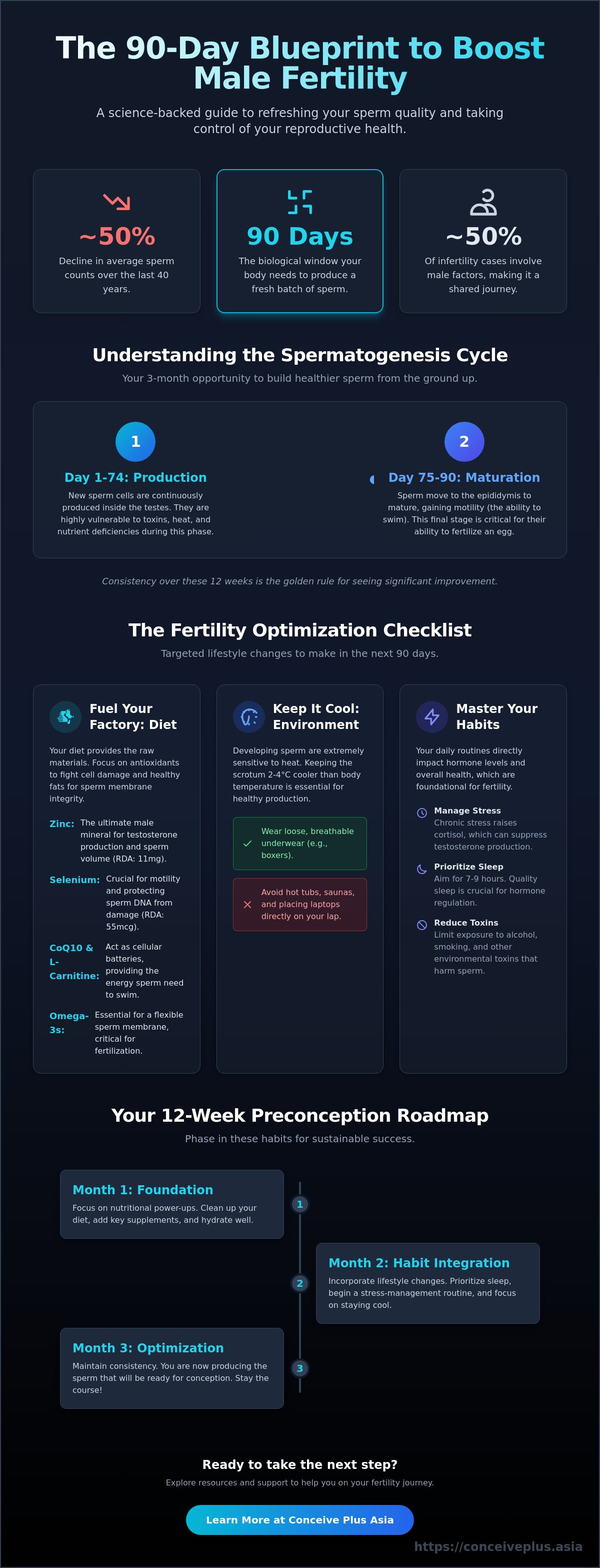
Ang spermatogenesis ay ang 90-araw na biyolohikal na paglalakbay mula sa isang simpleng germ cell hanggang sa isang ganap na mature na sperm cell na kayang mag-fertilize. Kasama sa prosesong ito ang mahigpit na 74-araw na yugto ng produksyon sa loob ng mga testis, na sinusundan ng humigit-kumulang 20 araw na yugto ng pag-mature sa epididymis. Sa loob ng tatlong buwang ito, ang mga umuunlad na sperm ay napaka-sensitibo sa mga panlabas na impluwensya tulad ng init, mga lason, at kakulangan sa nutrisyon. Ang pagiging consistent sa loob ng 12-linggong panahong ito ang gintong tuntunin dahil isang linggo lang ng masamang gawi ay maaaring makagambala sa maselang proseso ng pag-mature. Kung nais mong makita ang tunay na resulta, kailangan mong panatilihin ang bagong routine sa buong siklo.
Bakit Ang Pangangalaga Bago Magbuntis ay Isang Pinagsamang Responsibilidad
Kadalasang itinuturing ang pagkamayabong bilang isyu ng babae, ngunit iba ang sinasabi ng datos. Ayon sa CDC, mga salik ng kawalan ng pagkamayabong ng lalaki ay natutukoy sa humigit-kumulang 35% ng lahat ng mag-asawang nahihirapang magkaanak. Ipinapakita ng katotohanang ito kung bakit ang pangangalaga bago magbuntis ay dapat na isang pagsisikap ng buong koponan. Hindi lang ito tungkol sa pag-abot ng partikular na bilang ng sperm; ito ay tungkol sa kalidad ng sperm.
Ang kalidad ng sperm ay tumutukoy sa kalusugan ng DNA na dala sa loob ng selula, ang hugis ng sperm (morphology), at kung gaano sila kahusay lumangoy (motility). Mataas na bilang ay walang saysay kung hindi maabot o mapenetrate ng sperm ang itlog. Sa pagtutok sa mga pagbabago sa pamumuhay upang mapalakas ang pagkamayabong ng lalaki kasama ang iyong kapareha, lumilikha kayo ng isang suportadong kapaligiran na nagpapabuti ng tsansa para sa inyong dalawa. Ang proaktibong paraan na ito ay nagiging isang pinagsamang proyekto sa kalusugan mula sa isang nakaka-stress na medikal na hamon.
Checklist ng Diyeta para sa Pagkamayabong ng Lalaki: Mga Nutritional Power-Up
Kung ang 90-araw na siklo ng spermatogenesis ang iyong timeline ng proyekto, ang iyong diyeta ang nagsisilbing hilaw na materyales para sa pabrika. Maraming kalalakihan ang hindi alam na ang mga sperm cell ay napaka-sensitibo sa oxidative stress. Nangyayari ito kapag mas marami ang hindi matatag na molekula na tinatawag na reactive oxygen species (ROS) kaysa sa mga antioxidant sa iyong sistema, na nagdudulot ng pinsala sa mga selula. Kapag nag-commit ka sa mga pagbabago sa pamumuhay upang mapalakas ang pagkamayabong ng lalaki, ang iyong plato ang unang linya ng depensa. Sa pamamagitan ng pagbibigay ng partikular na mga micronutrient sa iyong katawan, lumilikha ka ng proteksiyon sa paligid ng mga umuunlad na sperm, na tinitiyak na sila ay mananatiling malakas at gumagana nang maayos.
Ang malulusog na taba ay isa pang kritikal na bahagi na madalas nakakaligtaan. Ang Omega-3 fatty acids, na matatagpuan sa matatabang isda at walnuts, ay mahalaga para mapanatili ang integridad ng panlabas na membrane ng sperm. Dapat maging malambot at flexible ang membrane na ito upang makapag-fuse ang sperm sa itlog. Kapag nakatuon sa pagpapabuti ng iyong fertility, ang pagpapalit ng trans fats ng mga mataas na kalidad na lipid na ito ay direktang makakaapekto sa galing ng sperm mo sa ilalim ng pressure.
Checklist: Mahahalagang Nutrisyon para sa Kalusugan ng Sperm
- Zinc (11 mg RDA): Madalas tawaging "ultimate male mineral," mahalaga ito para sa produksyon ng testosterone at dami ng sperm.
- Selenium (55 mcg RDA): Mahalaga ang trace element na ito para sa motility ng sperm at tumutulong maiwasan ang DNA fragmentation.
- L-Carnitine at CoQ10: Gumagana bilang mga baterya ng selula, nagbibigay ng enerhiya na kailangan para epektibong makalangoy ang sperm sa reproductive tract.
- Lycopene at Vitamin C: Malalakas na antioxidants na nag-neutralize ng ROS at pinoprotektahan ang genetic na laman sa bawat selula.
Para sa mga nais gawing mas simple ang kanilang pang-araw-araw na pagkain, ang mga fertility support bundles ay nagbibigay ng maginhawang paraan upang matiyak na palagi kang nakakakuha ng mga partikular na nutrisyon sa loob ng susunod na 12 linggo.
Mga Pagkaing Dapat Limitahan: Listahan ng "Pumatay ng Sperm"
Habang mahalaga ang pagdagdag ng magagandang bagay, kasinghalaga rin ang pagtanggal ng mga "pumatay ng sperm." Ang mga processed na karne, tulad ng bacon at deli meats, ay nauugnay sa pagbaba ng sperm morphology, ibig sabihin ay mas malamang na magkaroon ng abnormal na hugis ang mga selula. Ang high-fructose corn syrup ay isa pang salarin; ito ay nagdudulot ng insulin resistance na maaaring makagambala sa maselang balanse ng hormones na kailangan para sa produksyon ng sperm. Tungkol naman sa "soy debate," ipinapakita ng kasalukuyang pananaliksik na ang katamtamang pagkain ng buong soy tulad ng edamame ay ayos lang. Ngunit dapat iwasan ang mga highly processed na soy protein isolates na madalas makita sa murang protein bars, dahil maaaring makaapekto ito sa ratio ng estrogen at testosterone kapag kinain nang marami.
Para maging mas madali ang paglipat na ito, subukan ang mga simpleng palitan sa pagkain:
- Palitan ang processed deli ham ng inihaw na manok o salmon na nahuli sa ligaw.
- Palitan ang matatamis na soda ng green tea, na puno ng mga polyphenol na nagpapalakas ng fertility.
- Palitan ang puting tinapay ng quinoa o mga berdeng dahon upang mapanatili ang balanse ng iyong asukal sa dugo.
Maliit at tuloy-tuloy na pagbabago sa iyong pang-araw-araw na pagkain ay maaaring malaki ang maitulong sa pagsuporta ng iyong kalusugan sa reproduksyon at mapabuti ang iyong tsansa na magtagumpay sa pagbubuntis.
Mga Pangkapaligiran at Pisikal na Salik: Panatilihing Malamig ang "Pabrika"
Ang katawan ng tao ay kahanga-hangang epektibo, ngunit ang produksyon ng tamud ay may partikular na kahinaan: init. Hindi tulad ng karamihan sa mga panloob na organo, ang mga testicles ay nakalagay sa labas ng katawan sa isang dahilan. Kailangan nila ng temperatura na mga 1 hanggang 2 degrees Celsius na mas mababa kaysa sa iyong core body temperature upang gumana nang maayos. Kapag nag-overheat ang pabrika, bumabagal ang produksyon ng tamud, at maaaring bumaba ang kalidad ng umiiral na tamud. Ang pagsasama ng mga pagbabago sa kapaligiran sa mga pagbabago sa pamumuhay para sa pagkamayabong ng mga lalaki ay hindi lamang tungkol sa kaginhawaan. Ito ay tungkol sa pagpapanatili ng thermal stability na kinakailangan para sa malusog na spermatogenesis.
Karaniwang kapaki-pakinabang ang pisikal na aktibidad, ngunit may hangganan na dapat mong malaman. Ang katamtamang ehersisyo ay nagpapataas ng testosterone at nagpapabuti ng sirkulasyon. Gayunpaman, ang matinding endurance training o matinding pagbibisikleta ay maaaring magpababa ng bilang ng tamud dahil sa pisikal na trauma, pagkikiskisan, at pagtaas ng init ng skrotum. Bukod sa pisikal na temperatura, mahalaga rin ang kemikal na kapaligiran. Ang modernong buhay ay naglalantad sa atin sa mga endocrine-disrupting chemicals (EDCs) tulad ng BPA at phthalates. Ang mga sangkap na ito ay ginagaya ang estrogen sa katawan, na nagdudulot ng pagkasira ng balanse ng hormone na kinakailangan para sa pag-mature ng tamud.
Checklist: Pamamahala ng Temperatura ng Skrotum
Ang mga modernong gawi ay madalas na nagdudulot ng hindi sinasadyang pag-init. Ang mga laptop ang pangunahing salarin; ang paglalagay ng mainit na device nang diretso sa iyong kandungan nang ilang oras ay maaaring magpataas nang malaki ng lokal na temperatura. Gayundin, ang iyong pagpili ng damit ay may papel. Ang masikip na briefs o mga sintetikong tela ay nakakulong ng init at kahalumigmigan, samantalang ang maluwag na boxers ay nagpapahintulot ng mas magandang daloy ng hangin. Upang maisagawa ang epektibong mga pagbabago sa pamumuhay para mapabuti ang pagkamayabong ng lalaki, dapat mo ring pag-isipan muli ang iyong mga rutin sa pagpapahinga. Ang madalas na paggamit ng hot tubs, sauna, o kahit na mahahabang paliguan na may singaw ay maaaring pansamantalang huminto sa produksyon ng tamud nang ilang linggo. Manatili sa maligamgam na paliligo upang mapanatili ang tamang temperatura ng pabrika.
Checklist: Pagbawas ng Toxic Load
Ang mga microplastics at kemikal na additives ay lalong nauugnay sa pagbaba ng kalusugan ng tamud. Upang maprotektahan ang iyong reproduktibong kalusugan, ituon ang pansin sa pagbabawas ng iyong araw-araw na exposure sa mga mabibigat na ito. Magsimula sa kusina sa pamamagitan ng pagpapalit ng mga plastik na lalagyan ng pagkain sa salamin o stainless steel, lalo na kapag nagpapainit ng pagkain. Pinipigilan nito ang pag-leach ng BPA sa iyong mga pagkain. Bukod dito, piliin ang mga organikong produkto kung maaari upang mabawasan ang exposure sa pestisidyo, dahil maraming kemikal sa agrikultura ang kilalang nakakaapekto sa mga hormone ng lalaki. Kahit ang maliliit na pagbabago, tulad ng paggamit ng mga personal care products na walang pabango, ay makakatulong na mabawasan ang kabuuang toxic load at suportahan ang mas magandang morpolohiya ng tamud. Ang pagbabawas ng mga stressor sa kapaligiran ay mahalagang bahagi ng iyong mga pagbabago sa pamumuhay para mapabuti ang pagkamayabong ng lalaki sa susunod na 90 araw.
Ang Checklist ng Mga Gawi: Stress, Tulog, at Mga Sangkap
Ang iyong pang-araw-araw na gawain ay nagsisilbing biological project manager para sa produksyon ng sperm. Habang ang diyeta ang nagbibigay ng mga hilaw na materyales, ang iyong mga gawi ang tumutukoy kung gaano kaepektibo ang paggamit ng mga materyales na iyon. Isa sa pinakamahalagang pagbabago sa pamumuhay upang mapabuti ang fertility ng lalaki ay ang pamamahala sa tinatawag ng mga eksperto na Cortisol-Testosterone Seesaw. Kapag ikaw ay palaging stressed, inuuna ng iyong katawan ang kaligtasan kaysa reproduksyon. Ang mataas na antas ng cortisol, ang pangunahing hormone ng stress, ay aktibong pumipigil sa produksyon ng testosterone. Isang ulat noong 2024 mula sa American Psychiatric Association ang nagsabi na 43% ng mga matatanda ay nakaramdam ng mas mataas na pagkabalisa kumpara sa nakaraang taon, at ang matagalang tensyong ito ay isang pisyolohikal na hadlang na maaaring pumigil sa pag-unlad ng sperm bago pa man ito magsimula.
Ang tulog ay isa pang hindi maaaring ipagpaliban na salik sa 90-araw na proyektong ito. Karamihan sa paglabas ng testosterone ay nangyayari sa malalim at nakabubuting tulog. Kung palagi kang kulang sa pahinga, epektibo mong pinapabusog ang iyong reproductive system ng pangunahing enerhiya nito. Ang pagsisikap na makakuha ng pitong hanggang siyam na oras ng tulog ay hindi luho; ito ay pundamental na bahagi ng iyong plano para sa fertility. Sa pamamagitan ng pagbibigay-priyoridad sa pahinga at pagbabawas ng stress, lumilikha ka ng hormonal na kapaligiran kung saan ang sperm ay maaaring umunlad, hindi lamang mabuhay. Ang mga simpleng pagbabagong ito sa iyong iskedyul ay maaaring magbigay ng masukat na resulta sa iyong susunod na pagsusuri ng semilya.
Pag-optimize ng Balanseng Hormonal
- Hygiene sa Tulog: Sikaping magkaroon ng 7 hanggang 9 na oras ng nakabubuting tulog gabi-gabi upang mapalaki ang produksyon ng testosterone sa gabi.
- Pamamahala ng Stress: Maglaan ng 10 minuto araw-araw para sa mindfulness, paghinga, o meditasyon upang pababain ang antas ng cortisol.
- Katamtamang Galaw: Maglakad nang mabilis o mag-ehersisyo ng lakas ng katawan ng 30 minuto apat na beses sa isang linggo upang mapabuti ang sirkulasyon at kalusugan ng metabolismo.
Pagtigil sa Paggamit ng Substansya: Ano ang Dapat Itigil
Ang mga substansya tulad ng alak at nikotina ay direktang lason sa umuusbong na sperm. Bagaman ang paminsang pag-inom ay maaaring mukhang walang masama, ang "social drinking" ay madalas lumalampas sa hangganan kung saan nagsisimula itong pahinain ang motilidad at morpolohiya ng sperm. Ipinapakita ng pananaliksik na ang nikotina ay partikular na nakakasama, dahil ito ay direktang nauugnay sa fragmentation ng DNA ng sperm, na maaaring magdulot ng mas mababang tagumpay sa panahon ng konsepsyon. Ang mga recreational drugs, kabilang ang marijuana, ay napatunayang nakakaapekto rin sa morpolohiya ng sperm, na nagpapahirap sa sperm na lumangoy nang diretso o makapasok sa itlog. Mahalaga ring banggitin na ang paggamit ng anabolic steroids ay maaaring magdulot ng zero sperm count (azoospermia) sa pamamagitan ng pagsara ng natural na produksyon ng hormone ng katawan. Ang komprehensibong pagbabago sa pamumuhay upang mapabuti ang fertility ng lalaki ay nangangailangan ng malinis na simula upang maging tunay na epektibo.
Kung handa ka nang gawin ang susunod na hakbang sa iyong paglalakbay, maaari kang bumili ng aming hanay ng suporta sa fertility upang bigyan ang iyong katawan ng dagdag na tulong na kailangan nito sa mga pagbabagong ito sa gawi.
Implementasyon: Ang Iyong 12-Linggong Preconception Roadmap
Ang pagsasagawa ng kumpletong pagbabago sa iyong kalusugan ay maaaring maging nakakatakot, ngunit ang tagumpay ay nasa pag-unlad. Dahil ang produksyon ng semilya ay gumagana sa 90-araw na siklo, ang iyong 12-linggong roadmap ay idinisenyo upang unti-unting ipatupad ang mga pagbabago sa pamumuhay upang mapabuti ang pagkamayabong ng lalaki nang hindi nagdudulot ng burnout. Ang matindi at hindi napapanatiling mga pagbabago ay madalas na nauuwi sa kabiguan sa loob ng unang dalawang linggo. Sa halip, ituon ang pansin sa maliliit at tuloy-tuloy na tagumpay na nagkakaroon ng epekto sa loob ng tatlong buwan. Sa pagtatapos ng iyong ikatlong buwan, ang mga semilyang aabot sa pagkahinog ay makikinabang mula sa ganap na na-optimize na panloob na kapaligiran.
I-phase ang iyong mga pagbabago upang maging mas madali itong pamahalaan. Sa unang apat na linggo, ituon ang pansin sa nutrisyonal na pundasyon sa pamamagitan ng pagsisimula ng iyong supplement routine at paggawa ng mga pagbabago sa pagkain. Sa linggo lima hanggang walo, ituon ang pansin sa mga salik sa kapaligiran tulad ng temperatura ng scrotum at toxic load. Sa huling buwan, bigyang-priyoridad ang hormonal balance sa pamamagitan ng mahigpit na sleep hygiene at pamamahala ng stress. Tinitiyak ng phased approach na ito na hindi ka mabibigatan habang nagbibigay ng tuloy-tuloy na suporta sa iyong katawan upang mapabuti ang motilidad at bilang ng semilya.
Checklist: Pagsubaybay at Mga Kasangkapan
Hindi mo kailangang maglakbay nang mag-isa sa paglalakbay na ito. Ang pagsubaybay sa iyong progreso at paggamit ng mga magagamit na mapagkukunan ay makakatulong upang mapanatili kang motivated. Isaalang-alang ang mga hakbang na ito upang manatili sa tamang landas:
- Gumamit ng ovulation calculator upang itugma ang iyong pinakamainam na kalusugan ng semilya sa fertile window ng iyong kapareha, upang maging handa ka kapag pinakamahalaga.
- Magpanatili ng simpleng habit tracker para sa unang 30 araw upang makita ang iyong konsistensya sa mga bagong routine sa pagkain at ehersisyo.
- Basahin ang mga pagsusuri ng mga customer mula sa ibang kalalakihan na matagumpay na nalampasan ang mga pagbabagong ito upang makakuha ng praktikal na mga tip at emosyonal na suporta.
Kailan Humingi ng Propesyonal na Tulong
Bagaman makapangyarihan ang mga pagbabago sa pamumuhay, hindi ito kapalit ng medikal na interbensyon kapag talagang kinakailangan. Ipinapakita ng mga estadistika na humigit-kumulang 11.4% ng mga kalalakihang may edad 15 hanggang 49 sa Estados Unidos ang nakaranas ng ilang uri ng infertility. Kung ikaw ay wala pang 35 taong gulang at sinusubukang magkaanak nang 12 buwan nang walang tagumpay, panahon na para sa propesyonal na pagsusuri ng semilya. Gayunpaman, kung ikaw o ang iyong kapareha ay 35 taong gulang pataas, ang takdang panahon ay bumababa sa anim na buwan. Ipinapakita ng pananaliksik na ang mga mag-asawang may lalaking kapareha na 40 taong gulang pataas ay mas malamang na makaranas ng kahirapan, kaya't matalino ang maagap na pagsusuri.
Ang karaniwang pagsusuri ng semilya ay tinitingnan ang mga parametro tulad ng konsentrasyon, motilidad, at morpolohiya. Kung ang iyong mga resulta ay nagpapakita ng antas na "hypofertile," makakatulong ang isang espesyalista na tuklasin ang mga nakatagong medikal na isyu na maaaring hindi malulunasan ng pagbabago sa pamumuhay lamang. Para sa mas malalim na pag-unawa sa mga partikular na medikal na pagsusuri, bisitahin ang aming fertility blog. Tandaan, ang infertility ay madalas na isang bintana sa iyong pangkalahatang kalusugan, kaya ang paghahanap ng propesyonal na payo ay isang positibong hakbang para sa iyong kabuuang kagalingan.
Simulan ang Iyong 90-Araw na Pagbabago Ngayon
Ang pagpapabuti ng iyong kalusugan sa reproduktibo ay hindi isang gawain na natatapos sa isang gabi, ngunit ito ay isang napakarewarding na 90-araw na proyekto. Sa pamamagitan ng pag-unawa sa timeline ng spermatogenesis, natutunan mo na ang bawat malusog na pagpili na gagawin mo ngayon ay direktang nakakaapekto sa sperm na aabot sa maturity sa loob ng tatlong buwan. Kung pinapabuti mo man ang iyong diyeta gamit ang mga antioxidant, pinapalamig ang iyong kapaligiran, o inuuna ang nakapapahingang tulog, ang mga pagbabago sa pamumuhay upang mapalakas ang fertility ng lalaki ay lumilikha ng ideal na mga kondisyon para sa konsepsyon. Ang pagiging consistent ang iyong pinakamalaking kaalyado sa 12-linggong roadmap na ito; ang maliliit na tagumpay araw-araw ay nagdudulot ng makabuluhang pagbabago sa biyolohiya.
Habang nagpapatuloy ka, hindi mo kailangang mag-isa. Ang mga pormulasyong suportado ng agham ay maaaring magbigay ng nutrisyonal na seguro na kailangan mo upang manatiling nasa tamang landas. Maaari mong i-optimize ang iyong paglalakbay sa fertility gamit ang Conceive Plus Men’s Support Bundles, isang hanay na pinagkakatiwalaan ng milyun-milyong mag-asawa sa buong mundo. Sa mga pormulasyong dinisenyo para sa kalusugan ng reproduktibo at suportado ng positibong mga review mula sa mga totoong gumagamit, maaari kang maging kumpiyansa sa mga hakbang na iyong ginagawa. Manatiling nakatuon sa iyong mga layunin, suportahan ang iyong kapareha, at magtiwala sa proseso habang bumubuo kayo ng mas malusog na kinabukasan nang magkasama.
Mga Madalas Itanong
Gaano katagal bago mapabuti ng mga pagbabago sa pamumuhay ang kalidad ng sperm?
Tinatayang 90 araw bago makita ang resulta ng iyong mga pagsisikap sa mga parametro ng iyong semilya. Ang takdang panahon na ito ay tumutugma sa biyolohikal na siklo ng spermatogenesis, kung saan ang mga bagong sperm cells ay nangangailangan ng halos tatlong buwan upang ganap na maging mature. Anumang positibong pagbabago na gagawin mo ngayon ay makikita lamang sa susunod na batch ng produksyon. Mahalaga ang pagiging consistent sa panahong ito upang matiyak na ang buong yugto ng pag-mature ay suportado ng iyong pinabuting mga gawi sa kalusugan at nutrisyon.
Talaga bang maaaring magdulot ng infertility sa mga lalaki ang masikip na panloob?
Ang masikip na panloob ay maaaring negatibong makaapekto sa fertility sa pamamagitan ng pagtaas ng temperatura ng scrotum. Kailangan ng iyong mga testis na manatiling 1 hanggang 2 degrees Celsius na mas malamig kaysa sa pangunahing temperatura ng katawan upang makagawa ng malusog na sperm. Ang mga briefs o masikip na athletic gear ay nakakulong ng init laban sa katawan, na maaaring magdulot ng mas mababang bilang ng sperm. Ang paglipat sa maluwag na boxers ay isang simpleng paraan upang mapanatili ang ideal na thermal na kapaligiran at maprotektahan ang iyong mga umuusbong na sperm cells.
Nakakaapekto ba ang pag-inom ng alak sa bilang ng sperm nang permanente?
Ang epekto ng alak sa bilang ng sperm ay karaniwang hindi permanente, ngunit maaari itong magdulot ng makabuluhang pansamantalang pinsala. Ang labis na pag-inom ay nakakaistorbo sa balanse ng mga hormone na kailangan para sa produksyon ng sperm at maaaring magdulot ng abnormal na hugis ng sperm. Dahil ang iyong katawan ay nagrereporma ng supply ng sperm bawat tatlong buwan, ang pagtigil o malaking pagbabawas ng pag-inom ng alak ay maaaring magdulot ng nasusukat na pagbuti sa kalidad. Maaari mong asahan ang mga pag-unlad sa loob ng isang buong siklo ng 90 araw.
Mayroon bang mga partikular na bitamina na pinakamainam para sa pagkamayabong ng lalaki?
Oo, ang Zinc, Selenium, at Vitamin C ay kabilang sa mga pinakamahalagang nutrisyon para sa kalusugan ng reproduktibo ng lalaki. Ang Zinc ay sumusuporta sa antas ng testosterone, habang ang Selenium ay mahalaga para sa galaw ng tamud. Ang Vitamin C ay nagsisilbing malakas na antioxidant upang protektahan ang DNA ng tamud mula sa oxidative damage. Ang pagsasama ng mga ito sa balanseng diyeta o supplements ay isa sa mga pinakaepektibong pagbabago sa pamumuhay upang mapalakas ang pagkamayabong ng lalaki at matiyak na may sapat na mga sangkap ang iyong katawan.
Maaari bang magdulot ng mababang bilang ng tamud ang stress?
Ang matagalang stress ay maaaring magdulot ng mababang bilang ng tamud sa pamamagitan ng pagpapalabas ng cortisol. Ang hormon na ito ay pumipigil sa produksyon ng testosterone, na pangunahing nagpapasigla sa paggawa ng tamud. Ang mataas na antas ng stress ay nagpapataas din ng oxidative stress sa semilya, na maaaring makasira sa mga umiiral na selula. Ang pamamahala ng pagkabalisa sa pamamagitan ng mindfulness o regular na ehersisyo ay tumutulong sa pagbalanse ng iyong mga hormon at sumusuporta sa mas malusog na kapaligiran para sa reproduksyon sa loob ng 90-araw na siklo ng tamud.
Posible bang mapabuti ang morpolohiya ng tamud sa pamamagitan ng diyeta?
Maaari mong mapabuti ang morpolohiya ng tamud sa pamamagitan ng pagkain ng mga pagkaing mayaman sa antioxidants at malulusog na taba. Ang mga antioxidant tulad ng lycopene at Vitamin E ay nagpoprotekta sa umuusbong na tamud mula sa pinsalang nagdudulot ng abnormal na hugis. Ang Omega-3 fatty acids mula sa isda o walnuts ay tumutulong sa pagbuo ng matibay at flexible na mga cell membrane. Ang pagtutok sa mga partikular na pagbabago sa pamumuhay upang mapalakas ang pagkamayabong ng lalaki, tulad ng pagtaas ng antioxidant intake, ay nagbibigay ng pinakamainam na pagkakataon para makagawa ng tamud na may tamang hugis at gumagana nang maayos sa loob ng ilang buwan.
Gaano kadalas dapat mag-ejaculate ang isang lalaki upang mapanatili ang malusog na tamud?
Karamihan sa mga eksperto ay nagrerekomenda ng pag-ejaculate tuwing dalawang hanggang tatlong araw upang mapanatili ang pinakamainam na kalusugan ng tamud. Ang madalas na pag-ejaculate ay pumipigil sa pag-ipon ng matatanda at sira na tamud sa epididymis. Gayunpaman, ang sobrang madalas na pag-ejaculate, tulad ng ilang beses sa isang araw, ay maaaring pansamantalang magpababa ng bilang ng tamud. Ang regular na aktibidad ay nagsisiguro ng sariwang supply ng gumagalaw na tamud habang pinananatiling mataas ang konsentrasyon nito para sa mas magandang pagkakataon ng pagdadalang-tao sa panahon ng fertility ng iyong partner.
Nakakaapekto ba ang edad sa pagkamayabong ng lalaki tulad ng epekto nito sa pagkamayabong ng babae?
Habang mas dahan-dahan ang pagbaba kumpara sa mga babae, ang pagkamayabong ng lalaki ay bumababa rin nang malaki habang tumatanda. Ang mga lalaking lampas 40 taong gulang ay madalas nakakaranas ng pagbaba sa dami ng tamud, galaw nito, at kalidad ng genetiko. Ang pagtanda ay konektado rin sa mas mataas na antas ng DNA fragmentation, na maaaring magpahirap sa pagdadalang-tao o magpataas ng panganib ng pagkakaroon ng miscarriage. Ang maagap na pag-aampon ng malusog na mga gawi ay lalong mahalaga habang tumatanda upang mapagaan ang mga natural na pagbabagong biyolohikal na ito.


