
The Ultimate Prenatal Vitamins Buying Guide: How to Choose for 2026


Did you know that an estimated 90% of pregnant women don't get the recommended amount of choline? It's a staggering figure, especially considering how vital this nutrient is for fetal brain development. Choosing the right prenatal vitamins often feels like a high-stakes guessing game. You're likely balancing the fear of missing critical nutrients like DHA with the very real struggle of keeping a large pill down during morning sickness.
It's completely normal to feel overwhelmed by the debate over folic acid versus methylfolate or the 2026 shifts in heavy metal testing transparency. You want a supplement that supports your baby's growth without making your own physical symptoms worse. This guide will help you discover how to evaluate prenatal vitamins based on your specific clinical needs, delivery formats, and pregnancy stage. We'll provide a clear checklist of essential ingredients, explain the best time to start your regimen, and help you find a formula that's actually easy on your stomach.
Key Takeaways
- Understand why the first 28 days are vital for your baby's development and how early supplementation fills critical nutritional gaps.
- Identify the essential nutrients required for oxygen transport and neurological health, ensuring your chosen prenatal vitamins meet clinical standards.
- Learn to navigate the trade-offs between different delivery formats like gummies and tablets to find a formula that is gentle on your stomach.
- Use our final checklist to verify ingredient purity and confirm your supplement includes the recommended levels of DHA for brain health.
Why Prenatal Vitamins Are Essential Before and During Pregnancy
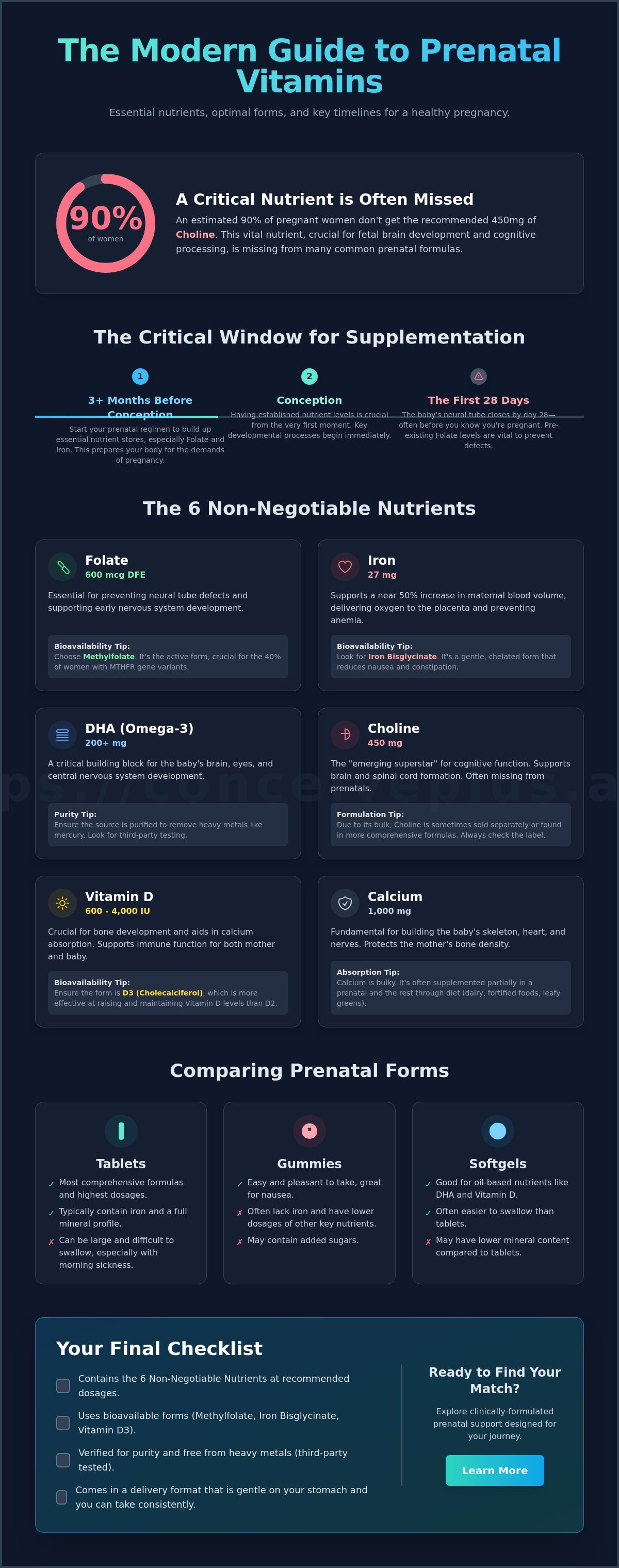
Many people assume that prenatal care begins only after a positive test. However, waiting until that moment means missing a critical window for your baby's development. Specialized prenatal vitamins are designed to bridge the gap between your dietary intake and the elevated demands of pregnancy. While a healthy diet is the foundation, research shows that 90% of pregnant women don't get enough choline; a nutrient vital for brain health. Standard multivitamins often lack the specific concentrations of iron and folate required to support two lives, making a targeted formula necessary for optimal outcomes.
To better understand how to select the right nutrients and what to look for on a label, watch this helpful video:
The Pre-Conception Advantage
Experts recommend starting a supplement regimen at least three months before you plan to conceive. This period allows your body to build up nutrient stores, particularly folate, which must be present in high concentrations from the very start. Since the neural tube closes by day 28 of development, often before you even realize you're pregnant, having these nutrients already in your system is a vital safeguard. You can use an ovulation calculator to better understand your cycle and time your nutritional support to align with your most fertile days. For a comprehensive overview of prenatal vitamins, it is useful to see how early intervention supports long-term health markers.
Preventing Developmental Deficiencies
Pregnancy requires a massive expansion of your blood volume, which typically increases by nearly 50% to support the growing fetus. This surge demands significantly more iron to prevent maternal anemia and ensure the placenta receives adequate oxygen. Without targeted support, your body may struggle to keep up with these rapid physiological changes. Early optimization of micronutrients like iodine and vitamin D also supports the baby's thyroid function and bone development. By focusing on these non-negotiable ingredients during the first trimester, you're providing the building blocks necessary for every major organ system to form correctly.
The 5 Non-Negotiable Nutrients Every Prenatal Should Contain
Selecting prenatal vitamins requires more than just checking for a long list of ingredients. You need to ensure the formula contains the right dosages in forms your body can actually use. Clinical standards for 2026 emphasize five core nutrients that directly impact fetal development and maternal health. These include folate for the nervous system, iron for blood supply, calcium and vitamin D for skeletal growth, DHA for the brain, and choline for cognitive processing. Missing even one of these can create nutritional gaps that diet alone may not fill.
While many products on the market claim to be comprehensive, they often fall short on the dosages recommended by major health organizations. Understanding how to choose a prenatal vitamin involves verifying these specific levels on the supplement facts label. For example, choline is an emerging superstar in prenatal health, yet it is still missing from a significant number of commercial formulas despite a recommended daily intake of 450 mg.
Dosage Requirements for 2026 Standards
Daily requirements shift significantly once you are expecting. The standard recommendation for iron is 27 mg daily to support the massive expansion of maternal blood volume. Folate needs also rise to 600 mcg DFE to ensure proper neurological development. For bone health, you should look for at least 600 IU of Vitamin D, though many experts in 2026 suggest levels up to 4,000 IU depending on your baseline. Calcium remains steady at 1,000 mg for adults, while DHA should be at least 200 mg to support the baby's eyes and brain.
The Importance of Bioavailability
Bioavailability determines whether a nutrient reaches your baby or simply passes through your system. Methylfolate is often superior to synthetic folic acid because it is already in its active form. This is especially important for the 40% of women with MTHFR gene variants who cannot convert folic acid efficiently. Similarly, iron bisglycinate is a chelated form that is gentler on the digestive tract than traditional iron salts, reducing the risk of nausea. For vitamin D, always look for D3 (cholecalciferol) over D2 to ensure better absorption and higher blood levels.
If you want to ensure you are getting a balanced mix of these bioavailable nutrients, consider starting with specially formulated supplement bundles designed for every stage of your journey.
Comparing Prenatal Forms: Tablets, Gummies, and Softgels
The delivery method of your prenatal vitamins can make the difference between consistent support and missed doses. While a tablet might contain every essential nutrient, it is useless if morning sickness prevents you from swallowing it. As you evaluate your options for 2026, you'll find that the market is split between high-density solids and high-palatability chewables. Each format has distinct trade-offs regarding nutrient stability, mineral content, and digestive comfort.
A major consideration is the "Iron Problem" found in most gummy supplements. Iron has a strong metallic taste that is notoriously difficult to mask with fruit flavors. Consequently, the vast majority of gummy options omit iron and calcium entirely. If you opt for a gummy, you must ensure your diet or a secondary supplement provides the 27mg of iron required for your blood volume expansion. Reviewing FDA guidelines on prenatal supplements can help you understand why these mineral gaps are so significant for maternal health and why consulting a provider about your specific form is necessary.
Traditional Tablets and Capsules
Tablets and capsules remain the gold standard for nutritional density. Because they don't require flavoring agents or binders used in chewables, they can pack higher concentrations of minerals into a single serving. They also tend to have a longer shelf life and better nutrient stability over time. However, the sheer size of these pills is a common complaint. If you struggle with a gag reflex, look for "mini" capsules or split your dose between morning and night to reduce the burden on your stomach.
Prenatal Gummies and Liquids
Gummies and liquid formulas have surged in popularity because they feel less like a chore. During the peak of the first trimester, when nausea is at its worst, a gummy might be the only thing you can tolerate. These forms are excellent for ensuring you at least get your folate and DHA. You should be aware that these often contain added sugars and may lack the stability of dry tablets. Because they often miss iron and choline, they are best used as a temporary solution during peak morning sickness or alongside an iron-rich diet. Always check the label to ensure you aren't sacrificing critical 2026 nutrient standards for the sake of flavor.
- Tablets: Best for comprehensive, one-pill-a-day coverage including iron.
- Softgels: Ideal for combining fat-soluble vitamins with DHA in an easy-to-swallow form.
- Gummies: Best for those with severe pill aversion, provided iron is sourced elsewhere.
- Liquids: A fast-absorbing alternative that can be mixed into smoothies to hide the taste.
How to Avoid Side Effects: Nausea, Constipation, and "Pregnancy Brain"
Many women find that the very supplements meant to support their health actually cause significant daily discomfort. Nausea and constipation are the most common complaints, often linked to the high iron content required for fetal development. Understanding why your body reacts this way is the first step toward finding a formula that works for you without the "pregnancy brain" fog or digestive distress. While the nutrients are non-negotiable, the way you consume them is entirely within your control.
Standard iron salts, like ferrous sulfate, are notoriously harsh on the stomach. By 2026 standards, many premium formulas have shifted to iron bisglycinate. This is a chelated form that is much easier to absorb and less likely to cause the dreaded "backup" in your digestive system. If you're still experiencing issues, check your label for fillers like titanium dioxide or artificial FD&C colors. These additives can sometimes trigger sensitivities in a pregnant system that's already working overtime. Transitioning to a "clean label" product often resolves these unexplained sensitivities.
Beating Prenatal Nausea
Taking your dose on an empty stomach is a common mistake that often leads to immediate queasiness. Shifting your routine to take your prenatal vitamins right before bed allows your body to process the nutrients while you sleep. This simple change often bypasses the peak nausea window. Some women find relief by splitting their daily dose into two smaller pills taken with lunch and dinner rather than one large tablet. Additionally, look for formulas that include Vitamin B6. This ingredient is clinically recognized for helping manage morning sickness and supplement-induced nausea.
Managing Digestive Changes
Beyond choosing a bioavailable iron form, lifestyle adjustments play a massive role in how you tolerate a new regimen. Increasing your water intake and focusing on high-fiber foods can mitigate the natural slowing of the digestive tract that occurs during pregnancy. It's also helpful to consult customer reviews to see how other women with similar sensitivities have fared with specific formulas. Real-world feedback often highlights whether a pill has a strong aftertaste or if it's truly "gentle" as claimed. If symptoms like severe constipation or vomiting persist for more than a week, it's time to talk to your doctor about switching to a liquid or gummy alternative temporarily.
Finding a balance between high-potency nutrition and daily comfort is essential for a healthy pregnancy. To find products designed with both in mind, you can explore high-quality prenatal support options that prioritize bioavailable and stomach-friendly ingredients.
Final Checklist: Choosing Your Ideal Prenatal Support
Selecting the right prenatal vitamins in 2026 requires looking beyond the marketing on the front of the bottle. With the passage of California SB 646 in late 2025, the industry is moving toward much higher transparency regarding heavy metals like lead, mercury, arsenic, and cadmium. Even if you don't live in California, you should look for brands that voluntarily publish third-party testing results for every lot. This ensures you aren't unknowingly exposing your developing baby to environmental toxins while trying to provide essential nutrients.
Your final selection should meet several non-negotiable criteria. First, confirm the presence of at least 200 mg of DHA, as this omega-3 fatty acid is critical for retinal and brain development. Second, verify that the folate content is at least 600 mcg DFE, preferably in the form of methylfolate to account for the 40% of women with MTHFR genetic variations. Finally, ensure the supplement includes choline. Since 90% of pregnant women are deficient in this nutrient, and it's often omitted from standard pills due to its bulk, its inclusion is a hallmark of a high-quality formula.
The Benefits of Support Bundles
Many women find that a single pill isn't enough to cover every nutritional base without being too large to swallow. This is where comprehensive nutritional bundles become a strategic choice. These systems are designed to work in synergy, often separating minerals like iron from calcium to prevent absorption interference. Using a bundle approach also ensures that you transition smoothly between life stages. Your needs during the pre-conception phase, where folate is the priority, differ from the third trimester, where iron and DHA demands peak. Kits often provide a more cost-effective way to secure premium ingredients like iron bisglycinate and active B-vitamins in one streamlined routine.
Taking the Next Step
Your journey toward a healthy pregnancy is an evolving process. Staying informed through educational maternal health blogs can help you adjust your strategy as you move from your first positive test through to the postpartum period. Knowledge is your best tool for managing symptoms and optimizing your baby's growth. As a final step, always take your chosen supplement bottle to your next appointment. Consult your OBGYN to ensure the specific dosages align with your unique bloodwork and health history. Starting your journey with a science-backed, stage-specific approach provides the best foundation for you and your baby.
Empower Your Pregnancy Journey with Confidence
Choosing the right prenatal vitamins is about more than just checking a box. It is about ensuring your body has the bioavailable nutrients like methylfolate and iron bisglycinate to support rapid fetal development. By focusing on third-party testing and stage-specific formulas, you can navigate the early months of pregnancy without the stress of nutritional gaps or severe digestive side effects. Your nutritional needs will evolve from pre-conception through postpartum, so staying flexible with your regimen is key to long-term health.
Ready to support your body and your baby with premium nutrition? You can Shop Science-Backed Prenatal Bundles designed by fertility experts for optimal absorption. These formulas are third-party tested for safety and purity; a standard trusted by millions of couples worldwide. You're taking a vital first step for your family's future, and with the right tools, you can feel confident in every choice you make. Your health and your baby's development are worth the extra care.
Frequently Asked Questions
When is the best time of day to take my prenatal vitamin?
The best time is usually right before bed or with your largest meal of the day. Taking your supplement at night can help you sleep through the initial digestive process, which often reduces nausea. If you find that the iron causes an upset stomach, avoid taking it on an empty stomach in the morning. Consistency is more important than the exact hour, so pick a time you won't forget.
Can I just take a regular multivitamin instead of a prenatal?
Standard multivitamins aren't sufficient because they lack the specific nutrient concentrations required for fetal development. Prenatal vitamins are designed with higher levels of iron and folate to support your expanding blood volume and the baby's nervous system. Most regular vitamins fall short of the 600 mcg of folate recommended for pregnant women, leaving your baby at risk for developmental gaps.
What should I do if my prenatal vitamin makes me constipated?
Switching to a formula that uses iron bisglycinate instead of ferrous sulfate can make a significant difference. This chelated form is much gentler on the digestive tract and is absorbed more efficiently. You should also focus on staying hydrated and increasing your fiber intake. If the issue remains, consult your healthcare provider about splitting your dose into two smaller servings or using a liquid supplement.
Do I need to take a prenatal vitamin if I have a very healthy diet?
Yes, even a perfect diet often fails to meet the intensive demands of pregnancy. It's difficult to consume the 450 mg of choline and 600 mcg of folate required daily through food alone. Using prenatal vitamins ensures you don't have nutritional gaps that could impact your baby's brain or spinal cord development during critical growth phases. It acts as an essential insurance policy for your health.
Is it safe to take prenatal vitamins if I am not yet pregnant?
It's highly recommended to start taking them three months before you begin trying to conceive. This allows your body to build up a reserve of essential nutrients like folate. Since the baby's neural tube closes within the first 28 days, having these nutrients already in your system is vital. It's generally safe for most women of childbearing age, though the extra iron isn't always necessary for those not trying.
What is the difference between folic acid and methylfolate?
Methylfolate is the active, natural form of the vitamin that your body can use immediately. Folic acid is synthetic and requires a specific enzyme to convert it into a usable form. Because about 40% of women have a genetic variation that makes this conversion difficult, methylfolate is often considered the more reliable option. It ensures that the nutrient is available to support your baby's neurological development from day one.
Does my prenatal vitamin need to have DHA in it?
DHA is essential for the baby's brain and eye development, so it's a critical addition to your regimen. Most experts recommend a minimum of 200 mg daily. If your chosen vitamin doesn't include it, you'll likely need a separate omega-3 supplement. Many women prefer a combined formula to reduce the number of pills they need to take, especially during the first trimester when swallowing large pills is difficult.
How long should I keep taking prenatals after the baby is born?
You should continue your supplement routine for at least six months postpartum, especially if you are breastfeeding. Your body's nutrient requirements remain high during lactation to support both your recovery and the baby's growth. Continuing your vitamins helps prevent depletion of your own stores of calcium, iodine, and iron. It also supports the nutritional quality of your breast milk during the demanding fourth trimester.


